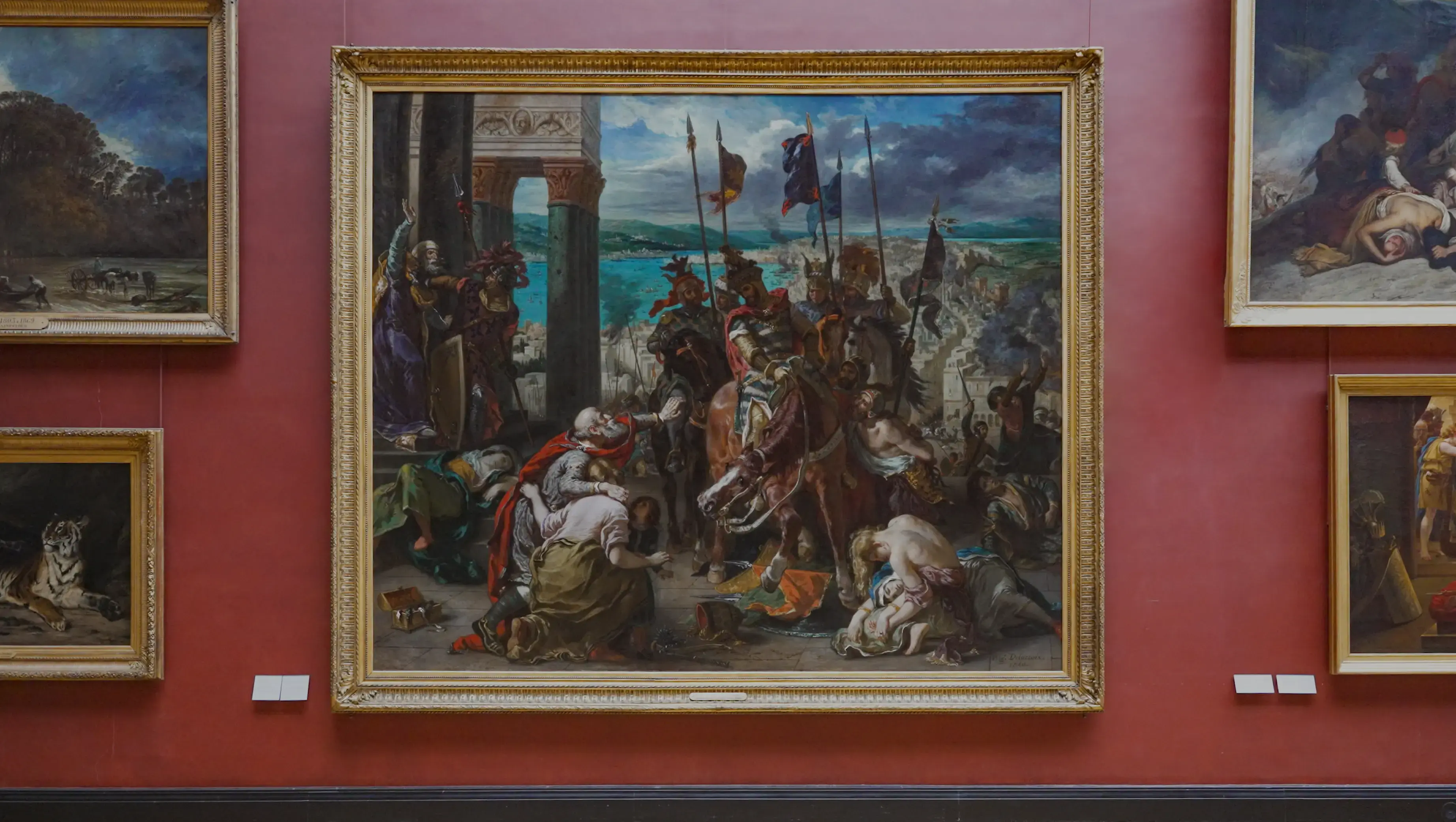
Following a meticulous course of conservation treatment, Eugène Delacroix’s Entry of the Crusaders into Constantinople is returning to the Red Rooms, joining a number of other famous works by the artist. By restoring the piece’s colours to their original brilliance, once darkened by yellowed varnish, the conservators’ work has allowed its complex significance to shine through once more.
Commissioned in 1838 by King Louis-Philippe I, the Entry of the Crusaders into Constantinople (12 April 1204) was one of many artworks intended to decorate the historical galleries of the Château de Versailles. The painting was completed in 1840 and displayed at the 1841 Paris Salon, then found a more permanent home in the neo-Gothic Crusades Rooms in Versailles. Counted as one of Delacroix’s masterpieces, it returned to Paris on several occasions, including the 1855 and 1864 retrospective exhibitions dedicated to the artist. By virtue of its artistic merit, the Administration of Fine Arts decided to transfer ownership to the Louvre in 1881, replacing it with a full-scale copy at the Château de Versailles.
Prise de Constantinople par les croisés (12 avril 1204), Eugène Delacroix, 1840, Département des PeinturesEntry of the Crusaders into Constantinople (12 April 1204), Eugène Delacroix, 1840, Department of Paintings
The Entry of the Crusadersinto Constantinople(12 April 1204) was one of the major works painted by Delacroix at the height of his career. The mandated subject was particularly violent and ambiguous: the artist fulfilled the order with a masterful example of history painting. He represented the sack of the capital of the Eastern Christian empire by Western Christian knights, who, diverting away from their initial objective of retaking the Holy City from Muslim control, took advantage of the political instability and financial debt in which the Byzantine Empire was mired.
Over the years, the painting’s old varnishes yellowed, darkening the picture and obscuring Delacroix’s chromatic effects. Conservation treatment undertaken between May 2025 and April 2026 reinforced the structure of the work – the canvas was mounted back onto its restored stretcher – and removed timeworn varnishes and materials left behind from previous restoration efforts from the pictorial layer. A new, transparent varnish was then applied, and the small gaps in the paint were filled in.
Restoring the Entry of the Crusaders into Constantinople (12 April 1204).
Scientific imaging revealed how the artist made every effort to exhaustively depict the violence of this historical event. Delacroix’s first concept included the corpse of a soldier, trampled by a horse, in the foreground; he then chose to hide it behind banners. This discovery explains the sharp movement of the horse’s head, and its terrified gaze staring directly at the viewer. The animal expresses the compassion that the victors are unable to feel towards their victims.
Image produced by the Thierry Radelet Laboratory. Detail of the reworked banners photographed in diffused light.Image produced by the Thierry Radelet Laboratory. Detail of the reworked banners photographed via digital radiography. These radiographic images were created with photostimulable phosphor storage plates scanned at 100 µm.
Delacroix also chose to highlight the plight of the enslaved women: shown in the foreground, they are emphasised by a vibrant colour scheme that makes them stand out from the other characters. By removing the dark screen of varnish that concealed the painting, the conservation treatment brought the colours much closer to the artist’s intended effect. His technical mastery now unveiled, the viewer can admire how he used an interweaving of colours, called flochetage, to give flesh tones an unprecedented vitality: the blues, purples, pinks, oranges, pale greens and warm greys meld together to render the captive woman’s nudity. The conservators’ work also restored the piece’s full depth of field, which is produced through various chromatic effects. In the background, white cities seem suspended in the emerald green of the mountains, which plunge down into turquoise-blue waters – they recall the watercolours of the Moroccan coast that the artist produced in 1832.
Entry of the Crusaders into Constantinople (12 April 1204), Eugène Delacroix, 1840, Department of Paintings. Detail
This substantial course of conservation treatment beautifully caps off a years-long conservation campaign of Delacroix’s large formats, which started in 2019.
The preliminary studies and the conservation of Entry of the Crusaders into Constantinople were performed thanks to the generous support of Ms Isabelle Ealet-Corbani.
Dina Belenkaya and the art of chess at the Musée du Louvre
Dina Belenkaya, born in 1993, has been playing chess since she was three years old. She became a chess grandmaster in 2016. Today, she plays chess internationally, while also balancing work as a social media content creator. To mark her two special chess matches being played at the Musée du Louvre – one against international master Julien Song, the other against 6-year-old prodigy Lucie – Belenkaya visited the collection of the Department of Decorative Arts. Here, she shares her take on four chess pieces and talks about how they fit into the way she sees her craft.
The team led by STUDIOS Architecture Paris and Selldorf Architects wins the bid
Restoring and transforming: such is the twofold aim of the ‘Louvre Nouvelle Renaissance’ project, a major renovation initiative launched in early 2025.
After a first appearance among the Egyptian antiquities in 2023, augmented reality is making a grand re-entrance: the Louvre and Snapchat are teaming up again to create an innovative interpretation tool for six of the museum’s departments, available from 18 February 2026.